Saturday, March 16, 2013

Tree Removal Update

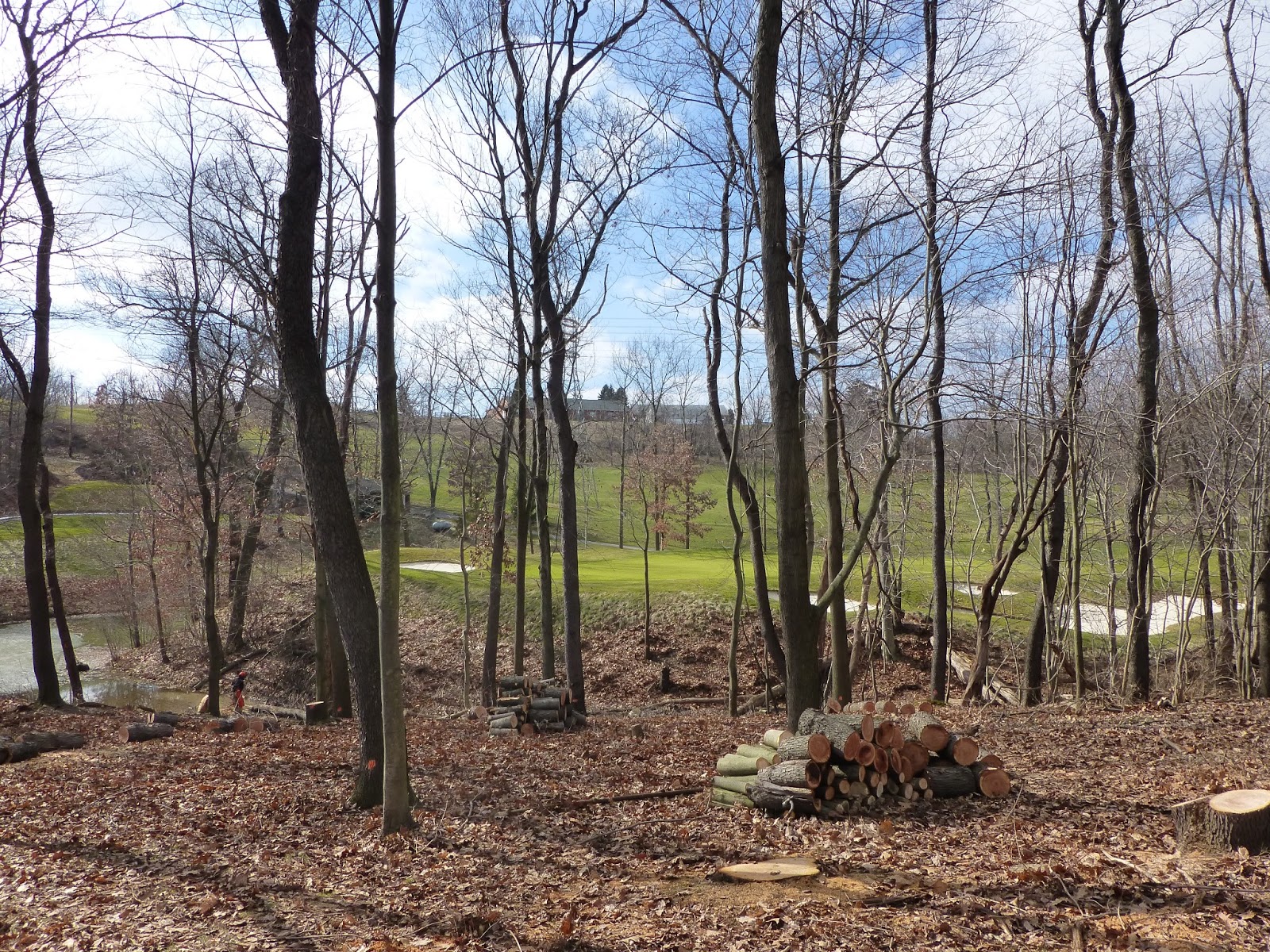
The staff has been making great progress on the tree removal list.  After completing the removals at 14 tee we moved on to 9 green.  We are awaiting a piece of rental equipment that will make the process of removing the last few trees out of the ravine more efficient, and safer.  Right now the only way to remove the wood is by walking up a steep bank that is very slippery.  The rental machine is perfect for this type of work because it will pick up the wood and place it higher on the bank where we can then handle it.  I'll be sure to take plenty of pictures to share with you.  While #9 was on hold we've been able to remove the trees along the back right of 4 green, along the cart path at 17 tee, at the parking area for 8 green, and we are currently working to the left of 14 green.  Most of the removals are Ash trees that were killed by the Emerald Ash Borer, and the remainder are either native Cherry trees that have reached the end of their life span, or Oaks and Maples that are compromising turf health.  I've included some pictures below to illustrate our progress.


Creating more light and airflow left of 9 green

Cutting up trees in ravine at 9 green

4 green - before

4 green - after.  Trees removed back right of green

17 tee - before

17 tee - after

8 green.  Cutting up dead Ash tree

14 green.  Removing dead Ash trees and exposing original rock wall

Tuesday, February 12, 2013

In Case You Missed It

Is there a way to receive updates from the blog without having to go to the website?

Yes, on the right side of this page under the Club's logo is an empty box where you can enter your e-mail address.  After entering an address hit the submit button and every time a new post is added you will automatically receive an e-mail containing the post, including any pictures along with a link back to the blog.  This is also an easy way to share information by forwarding the e-mail you receive to others not familiar with the blog.

Another way to receive updates is by following me on Twitter.  There is a link just below the Follow By E-mail box, and I send out a tweet every time a new post is added to the blog.

Thanks for your continued interest!
Friday, February 8, 2013

Tree Removal

Here at Diamond Run, trees are removed for safety reasons and/or to improve the health of the turf.  Safety is always our top priority, and dead or declining trees pose a hazard to everyone who uses the golf course.  As for turf health, removing trees is sometimes the only option in providing acceptable playing conditions.  The foliage from trees growing too close to greens and tees will prevent sufficient sunlight exposure and air circulation for optimal turf growth.  As I became familiar with the golf course last season, numerous trees were identified that fit the criteria above.  The first area we addressed was the grove of trees to the right of #14 tees.  All of the trees there were either dead, or in a state of decline that posed a major safety hazard, and had to be removed.  The area we began working on most recently is to the left of #9 green.  The location of the green and the density of trees causes significant turf thinning every year and will continue unless more sunlight and air circulation is provided.

#14 tee - notice the deadwood (hazards) in all the tree tops


#9 green on July 25th at 9am - dense tree canopy on the
left provides undesirable morning shade

Wednesday, January 23, 2013

Deep Freeze

The frigid temperatures we experienced this morning were some of the coldest that I can remember in several years.  And even though we don't always like it, the cold weather benefits the golf course.  Freeze/thaw cycles, along with frost heaving, is nature's way of aerifying and occurs when soil moisture freezes.  The resulting ice fractures the soil and literally pushes it apart, creating new channels for air and water.  As the temperature warms in the Spring the heaved soil will return to normal as it thaws, but some of the fractures that formed during the winter will remain.  These fractures allow for improved air, water, and nutrient movement, which ultimately leads to new root growth.  The other benefit of cold weather is the suppression of insect, fungal pathogen, and weed populations.  Mild winters the last couple of years have allowed the populations of these pests to grow, and our primary means of control has been through chemical use (insecticides, fungicides & herbicides).  If we continue to experience freezing temperatures over the next couple of months the populations could be reduced to a level that allows us to use less pesticides during the season.

Friday, January 11, 2013

Course Update 1/11/2013

Even though the forecast calls for milder temps, the golf course will be closed to all play this weekend.  There was still a considerable amount of snow in some areas this morning, which when combined with the rainfall during the day and already saturated ground, leads to an extremely wet golf course.  Compaction occurs very easily under these conditions, and walking on saturated turf can have lingering effects.  A good practice after snow melt/rain events during the winter is to check all the surface drains and make sure they are not blocked and working properly.  Standing water around a backed up drain will turn into ice which can kill turf if it persists for too long.