Wednesday, December 9, 2015
Blog Update
I realized that some of the links in the right-hand column were not working properly, but they have been updated as of today. Of particular interest to golfers and the membership may be the Course Management Resources and USGA Educational Videos sections. The related links will take you to the USGA's website where they have a wealth of information detailing how and why golf courses are managed in a particular way.


Tuesday, December 8, 2015
Winter Prep
A light layer of topdressing sand was applied to the putting surfaces this week following our regular application of snow mold fungicides. Snow mold diseases will occur with or without snow cover, in cool, wet weather. The disease will kill turf if left untreated, and we try to spray as late as possible in the year to ensure the application will last 3+ months. The next step in protecting the turf is to apply topdressing sand that protects and insulates the growing point (crown) of the plant. Think of the sand layer as a blanket that helps regulate the environment around the plant, preventing it from getting too cold or too dry during the winter. The topdressing sand will be washed into the turf canopy during the next couple of rain events, and is a benefit to the golfer by way of smoothing the putting surface. A similar application of topdressing sand will be applied to the par-3 tees and other heavily used tees in the next couple of days, along with some of the approaches that tend to stay wet. In this situation, the sand layer allows water to move into the rootzone easier, thereby creating a firmer playing surface.
 |
| Topdressing #17 Green |
Wednesday, October 7, 2015
Course Update
A quick reminder that the golf course will be closed for aerification from Tuesday 10/13 thru Friday 10/16. The driving range will remain open, but please check with the golf shop for hours of operation. Historically, the course would be closed two days for greens aerification, while tees and fairways would be aerified in play. That resulted in a significant amount of disruption to you and your guests, and the process was not completed as efficiently as we would have liked. So this year the Club decided to close for two additional days to focus on the aerification process, which will result in less disruption during your next round. Thank you for your patience while we work to improve the golf course!
Tuesday, June 30, 2015
Course Update
Over 7" of rain has fallen in the past two weeks and the soggy conditions have made it necessary to open up the putting surfaces. There are many names for this process; Venting, Pencil Tining, Needle Tining, etc. Whatever you call it, there's no denying it's role in maintaining healthy turf. The process starts by using 1/4" diameter solid tines on our greens aerifier. The tines have a fixed lateral spacing of 1 1/2", but the forward spacing is adjustable from 1 1/2" to 3". A tighter spacing may offer better results, but you can easily damage sensitive turf because you are disrupting a larger percentage of surface area. The depth the tines penetrate is also adjustable, and we set our machine to aerify as deep as possible without damaging the putting surface. The purpose of venting the greens is to create pathways (holes) for toxic gas to escape, while also allowing oxygen, water, and nutrients to easily enter the rootzone. Another benefit during prolonged wet periods is water can evaporate easier from the rootzone by way of the holes. Immediately after the green is aerified, the surface is rolled smooth and is ready for play. In a couple of days the holes on the surface will disappear, but the holes below ground will remain open for several weeks providing long-term benefits to the turfgrass and soil.

Interesting Facts About Golf Courses
Presented by the Golf Course Superintendents Association of America
- A properly repaired ball mark heals completely in 2-3 days, while an unrepaired ball mark takes 15-20 days to heal properly.
- A typical 18-hole golf course covers approximately 125 - 150 acres of land. The total landmass of golf courses in the United States equals about 1/2 the state of Connecticut.
- A typical 18-hole golf course produces enough oxygen to support 4,000 to 7,000 people.
- Golf courses nationwide combine to filter 13 million tons of dust from the air every year.
- Who is the most important person at a golf facility? According to a 1997 survey of 500 Golf Digest subscribers, the golf course superintendent was listed the most (48 percent). Other responses included the course/club professional 25 percent, club/course manager 14 percent, beverage cart or halfway house person 11 percent.
- Golf courses have a cooling effect during the hot summer months. The average temperature on the golf course is typically 5- 7 degrees cooler than a residential area and 7 - 15 degrees cooler than an urban downtown setting.
- The infield of the Indianapolis Motor Speedway is home to four holes of the Brickyard Crossing golf course. The remaining 14 holes outside the oval are accessed through a tunnel under the track.
- Golf courses delay play on frost-covered turf (especially greens) because stepping on frost-covered grass causes the frozen leaf cells to rupture. The turf will turn brown and eventually die.
- The Old Works Golf Course in Anaconda, Mont., is the first golf course built on an Environmental Protection Agency Superfund Site. Designed by Jack Nicklaus, the land served as a smelting location for the mining of iron ore. The golf course opened in June of 1997.
- Why do golf course superintendents aerate turf? Because it reduces compaction on a golf course by removing soil cores from the ground, allowing the movement of water, air and nutrients to the turf roots. Highly traveled areas plus poor soil composition creates compacted surfaces.
- What is the origin of the stimpmeter? In the early 1900s, a man by the name of Edward Stimpson was looking for a means to create more fairness in the game of golf. Specifically, he was looking to make putting surfaces on a particular course all relatively the same speed. He developed the stimpmeter to achieve this purpose. By using this device, he could determine, for example, if the fourth green was the same speed of the 17th. The device is often misused and misinterpreted by the novice and avid golfer alike. It is best used to compare greens on the same course, NOT to compare greens from one course to another.
- How much has technology and research improved speed and quality of a putting green? In the early 1960s, professional tour event superintendents cut putting green turf heights at about 1/4 inch. Today, the height of putting green turf for professional tournament competition is 1/8 inch or less.
- How do trees affect the quality of a putting surface? All things being equal, a putting green with air circulating around it will be in better shape than a green with little or no air circulation. Trees tend to reduce circulation, thereby having a negative effect on putting green quality. Older, more mature trees adjacent to putting greens will negatively impact surface conditions because the tree roots will grow under the putting surface and disrupt the flow of water and nutrients.
- What is a golf course superintendent doing when he/she syringes a green? Syringing is the process of spraying a light cover of water on a green during hot weather to reduce the temperature of the turf. This prevents putting surfaces from becoming “baked” or “dried-out,” and having a negative impact on putting surface quality.
- What is topdressing? It is the practice of spreading material over a putting green to level and smooth the surface. The material is generally sand and/or organic matter that improves drainage, controls thatch and maintains biological balance.
- Golf courses have a positive impact on the economy. It is estimated that more than 25 million people annually spend 2.5 billion hours outside, playing one of the nation’s 17,000-plus golf courses. The impact of golf facilities on the economy is $20 billion annually.
Saturday, May 23, 2015
Course Update - Tee Service
A change to the operation this year is dedicating a staff member to servicing all the tees on the golf course every day. The task requires someone who pays attention to every detail, and consists of moving and properly aligning tee markers, filling divots, trimming around tee plaques, blowing debris from the tee surface, refilling divot bottle stations, picking up trash, etc. By doing this we have eliminated the need for divot boxes on the par-3 tees.
Friday, April 17, 2015
Course Update
It's amazing how much the golf course has greened up in the last week. So much so, that we have started to mow rough and fairways on a regular basis. Tees & greens are always slower to come out of dormancy, but they too have shown good color in the last few days. Even though we recently aerated the greens, overall they are in better condition now than this time last year. A few greens still have some unsightly winter damaged areas, but there is plenty of green tissue when you poke around in the canopy. Similar to last year, we are utilizing every resource available to help the recovery process, but ultimately the turf will respond when it's ready. A little patience now will yield extraordinary results this summer.
Here's a quick summary of what my amazing staff accomplished this week:
Greens aerified, topdressed, dragged, fertilized and rolled
Course cleanup (It never ends!!)
Irrigation system filled and several repairs made
Old sand removed, edging done, drainage repaired, and new sand installed at the practice bunker
Clubhouse and surrounding landscaping dialed in
Throw in mowing and other regular maintenance activities and you can see why we stay so busy.
Here's a quick summary of what my amazing staff accomplished this week:
Greens aerified, topdressed, dragged, fertilized and rolled
Course cleanup (It never ends!!)
Irrigation system filled and several repairs made
Old sand removed, edging done, drainage repaired, and new sand installed at the practice bunker
Clubhouse and surrounding landscaping dialed in
Throw in mowing and other regular maintenance activities and you can see why we stay so busy.
Sunday, September 21, 2014
Course Update
Cooler weather and shorter days signal the beginning of Fall, and that means it's aerification season. All the par-3 tees have been aerified and a sand/seed mix was put down to smooth the teeing surface and promote recovery. The remaining tees will be aerified over the next few weeks as time and weather allows. Greens aerification is scheduled for October 14 & 15, and the golf course will be closed both days. Please check with the Golf Shop regarding hours of operation for the driving range those two days.
This time of year is also when we pick away at our project list, and the first item is renovating the six foot wide step-cut of rough around fairways. The rough is comprised of Kentucky Bluegrass, turf-type Fine & Tall Fescues, and Perennial Ryegrass. Over the past 20 years the step-cut has become contaminated with bentgrass that has spread out from the fairways, which creates playability and maintenance issues. Bentgrass is ideally suited for greens, tees and fairways at a height of cut of .500" or lower. When maintained higher than .500" golf balls will sink down and the thick turf will grab the club head and cause unexpected errant shots. Bentgrass is also susceptible to certain diseases and having to spray these extra areas takes a toll on our limited resources. There are a couple of options we considered to remedy this problem. The first is to strip all the contaminated sod in the step-cut and lay new sod containing the grasses mentioned above. This was impractical due to time and cost restraints, plus when bentgrass sod is cut any roots remaining in the soil will give rise to new plants and contaminate the new sod in 2-3 years. The option we chose was to spray a herbicide that only targets the bentgrass plant and overseed with the desirable rough grasses. The white turf you see is the bentgrass dying from the herbicide application, while the desirable turf remains green and unaffected. The white ring around the fairways is not something I care for, but it's a great visual indicator that the herbicide is working. It also shows how much bentgrass contamination there really is. Overseeding is scheduled to be done this week, and a final herbicide application will follow shortly after to ensure all the bentgrass is dead. Another unique aspect of the herbicide is you can seed before or after an application and it will not injure new seedlings.
Saturday, May 17, 2014
Course Update
Mother Nature has not been kind to us over the past week and a half, which has made it difficult to provide decent playing conditions. We've received over 4" of rain since last Wednesday, combined with temps in the mid-80's, that caused the turf to start growing at an accelerated rate. The weather seemed to affect the putting greens the most, where semi-dormant turf changed overnight into lush, green grass that was slow and bumpy. Our maintenance practices have changed accordingly to better manage all playing surfaces, and the cooler temps forecasted for the upcoming week will naturally reduce the growth.
Putting greens on holes 3, 10, 11, 12 and 13 still have areas that haven't fully recovered from the winter. Until recently, the cooler, drier weather has hindered turf recovery, but the warmup is a good thing and I have seen noticeable improvement. Our verticutting and topdressing program seems to be working and we will continue the process until the areas are filled in.
Putting greens on holes 3, 10, 11, 12 and 13 still have areas that haven't fully recovered from the winter. Until recently, the cooler, drier weather has hindered turf recovery, but the warmup is a good thing and I have seen noticeable improvement. Our verticutting and topdressing program seems to be working and we will continue the process until the areas are filled in.
Thursday, February 13, 2014
Tree Removal Update
The removal of dead and hazardous trees continues, despite the relentless winter weather. My biggest complaint is the increasing snow depth. Certain areas on the course are inaccessible due to snow drifts and cart paths that are iced over under a thick layer of snow. We've managed to get around without much damage, but staff safety is always the top priority and we will never do anything to jeopardize that. Considering the challenges we've faced, the attitude and perseverance of the staff has been awesome! Our goal of being finished with tree removals by the end of February looks more certain every day.
The area we're currently focused on is between 10 green and 11 tees. Most of the trees in this area are ash that have been killed by the Emerald Ash Borer and are covered with poison ivy vines, which makes removal that much harder. Even though it's winter the sap that causes irritation will leak out of cut vines and is just as potent as it is in the summer. Below are some pictures from this area, along with a few others you may not have seen.
The area we're currently focused on is between 10 green and 11 tees. Most of the trees in this area are ash that have been killed by the Emerald Ash Borer and are covered with poison ivy vines, which makes removal that much harder. Even though it's winter the sap that causes irritation will leak out of cut vines and is just as potent as it is in the summer. Below are some pictures from this area, along with a few others you may not have seen.
 |
| Having the right tools allows us to chip an entire tree |
 |
| Left of 10 green (before). Notice all the brush and vines |
 |
| Clearing underway on 10 looking towards 11 green |
 |
| A cherry tree with obvious structural damage removed for safety reasons |
 |
| A maple tree also removed for safety reasons |
 |
| Dying or dead upper branches indicate a problem |
Friday, January 31, 2014
Course Amenities
When it's too cold to safely work outside the staff has been busy designing and fabricating new course amenities for the upcoming season. New posts will replace the flag sticks on the driving range target greens and will be more visible from the tees. We are also trying a new design with the tee markers, while keeping the diamond as an integral feature. Five sets of tees per hole requires 180 individual markers, which took 70 total man hours to cut, sand, stain, paint and install screws.
 |
| New tee marker design |
 |
| Completed markers ready for the season |
 |
| Staining driving range posts |
Tuesday, October 8, 2013
Course Update
Just a reminder that the golf course will be closed Monday and Tuesday, October 14th and 15th for greens aerification. While the course is closed two different contractors will be on site installing a new power line to the restrooms behind 15 green, and a much-needed guard rail along the cart path from 6 green to 7 tee. This is the best time to complete these two projects since the course is closed and there won't be any disruption to the membership.
Thursday, July 11, 2013
Course Update
Including yesterday's storms, 7.25" of rain has fallen since June 26th. That's a large amount of water for the course to handle over 15 days, but it could have been a lot worse. Some areas around us received double that amount. In my 20+ years of managing golf courses I have come to realize that too much water is far worse than not enough water. On a positive note, the extended forecast calls for cooler, drier weather over the next several days, then the mercury starts to climb again as we get closer to the Men's Invitational. The timing couldn't be any better in allowing the course to dry out and firm up for the event.
In addition to cleaning up debris from yesterday's storms, today we were able to mow and roll greens, mow primary and intermediate rough, mow collars, fix washouts and rake all bunkers, spray greens, and trim yardage markers in the fairways and tees. It's been several days since the last mowing, but tomorrow's plan is to mow fairways, approaches and tees, and we will be spraying fairways.
Thursday, June 13, 2013
Tree Stumps...Update
It took a couple weeks, but all 110 tree stumps have been ground and cleaned up. The final step in the process is to fill the holes with a soil/compost blend and sow seed. The stumps located in maintained rough areas will be seeded with a Kentucky Bluegrass/Turf-Type Tall Fescue blend, and those in the outer rough will be seeded with a Fine Fescue Links blend. We will continue to paint the stump areas as ground under repair until the new turf matures and can withstand play.
 |
| Grinding stumps at #14 tee |
Saturday, April 20, 2013
Tree Stumps
Why are there tree stumps with white paint on them? Over 100 stumps throughout the property need to be removed and have been marked with white paint. The paint makes it easy to see the stumps during tours with contractors who are bidding on the work. Once stump grinding begins the contractor will move through the property in the most efficient way possible, so please be aware that they will be working in play. After the stumps are ground the maintenance staff will cleanup the debris, fill the holes with soil, and either seed or sod the area depending on the location.
Aerification Update
 It's only been five days since the putting greens were aerified, but I am pleased with the healing thus far. The two rain events and summer-like temps last week certainly helped, and the mild weather forecasted for next week will make up for this weekend's cold spell. Speaking of next week, the greens will be mowed once we see enough turf growth to minimize the amount of sand picked up by the mowers. While the greensmowers are parked, lightweight rollers are being used to smooth the putting surfaces and move sand into the leaf canopy.
 Friday, April 12, 2013
Time To Punch Some Holes
The equipment is ready to go and the weather forecast looks good for greens aerification on Monday. We are using slightly smaller tines than previous aerifications, but are still pulling a core and backfilling with sand. The reason for using a smaller diameter tine is to reduce the amount of surface disruption which allows the putting surface to heal faster. I anticipate a full recovery of the greens in two weeks, unless a stretch of really cold weather settles in. Additionally, the golf course will only be closed on Monday for aerification and will re-open for play Tuesday morning.
Tuesday, April 9, 2013
Colorful Putting Greens
The putting greens are a mixture of Bentgrass (Agrostis palustris) and Annual Bluegrass (Poa annua). They typically have a blotchy or patch-like appearance this time of year given normal weather patterns, but the color variation is not an indication of poor turf health. Bentgrass is the slowest to come out of dormancy, and tends to take on a darker appearance during the cooler months. Poa on the other hand is first to break dormancy, and is further differentiated based on whether it's a perennial or true annual biotype. Similar to Bentgrass, the perennial biotypes tend to have a darker appearance, while the annual biotypes appear more lime green. Some of what you're also seeing is old leaf tissue from last season, which makes the putting surface appear white or tan. That tissue will be removed with each successive mowing as the plants resume their active growth and produce new tissue. With a few more warm days and a little rain, the turf will "wake up" and the color variations should be less noticeable. Thinking back to last season, the variations were not as noticeable because the turf never went completely dormant due to the mild winter and the early, warm spring.
Thursday, April 4, 2013
Course Update
Although the calendar says it's Spring, I would argue that Winter had us in a death grip for too long this year. But that looks to be changing today, as the forecast calls for temps in the 50's and a steady warmup over the next several days. We'll still have cold mornings and frost delays are very likely this time of year, but the maintenance staff are just as excited as you are to be back outside.
Until now our focus with the full-time staff has been on refurbishing equipment, snow removal, and tree work. This week a few of the seasonal staff returned and began the annual ritual of course cleanup. It will take several days to get through the entire course and clean all the playing surfaces prior to the first mowing. In addition to the cleanup, new hole locations have been cut, and tee markers and bunker rakes have been set out. Speaking of bunkers, the plan is to begin prepping them next week. It may take up to a week to clean out the debris, fix washouts and move sand that settled in the low areas from the long Winter. The other thing I'm sure everyone will start asking about is greens aerification. As of now, our plan is to begin aerifying on Monday 4/15. We may need to remain closed on Tuesday 4/16 to complete the process, but that decision will be made next week.
Check out these pictures of the machine used during tree removal to the left of 9 green.


Until now our focus with the full-time staff has been on refurbishing equipment, snow removal, and tree work. This week a few of the seasonal staff returned and began the annual ritual of course cleanup. It will take several days to get through the entire course and clean all the playing surfaces prior to the first mowing. In addition to the cleanup, new hole locations have been cut, and tee markers and bunker rakes have been set out. Speaking of bunkers, the plan is to begin prepping them next week. It may take up to a week to clean out the debris, fix washouts and move sand that settled in the low areas from the long Winter. The other thing I'm sure everyone will start asking about is greens aerification. As of now, our plan is to begin aerifying on Monday 4/15. We may need to remain closed on Tuesday 4/16 to complete the process, but that decision will be made next week.
Check out these pictures of the machine used during tree removal to the left of 9 green.


Saturday, March 16, 2013
Tree Removal Update
The staff has been making great progress on the tree removal list. After completing the removals at 14 tee we moved on to 9 green. We are awaiting a piece of rental equipment that will make the process of removing the last few trees out of the ravine more efficient, and safer. Right now the only way to remove the wood is by walking up a steep bank that is very slippery. The rental machine is perfect for this type of work because it will pick up the wood and place it higher on the bank where we can then handle it. I'll be sure to take plenty of pictures to share with you. While #9 was on hold we've been able to remove the trees along the back right of 4 green, along the cart path at 17 tee, at the parking area for 8 green, and we are currently working to the left of 14 green. Most of the removals are Ash trees that were killed by the Emerald Ash Borer, and the remainder are either native Cherry trees that have reached the end of their life span, or Oaks and Maples that are compromising turf health. I've included some pictures below to illustrate our progress.
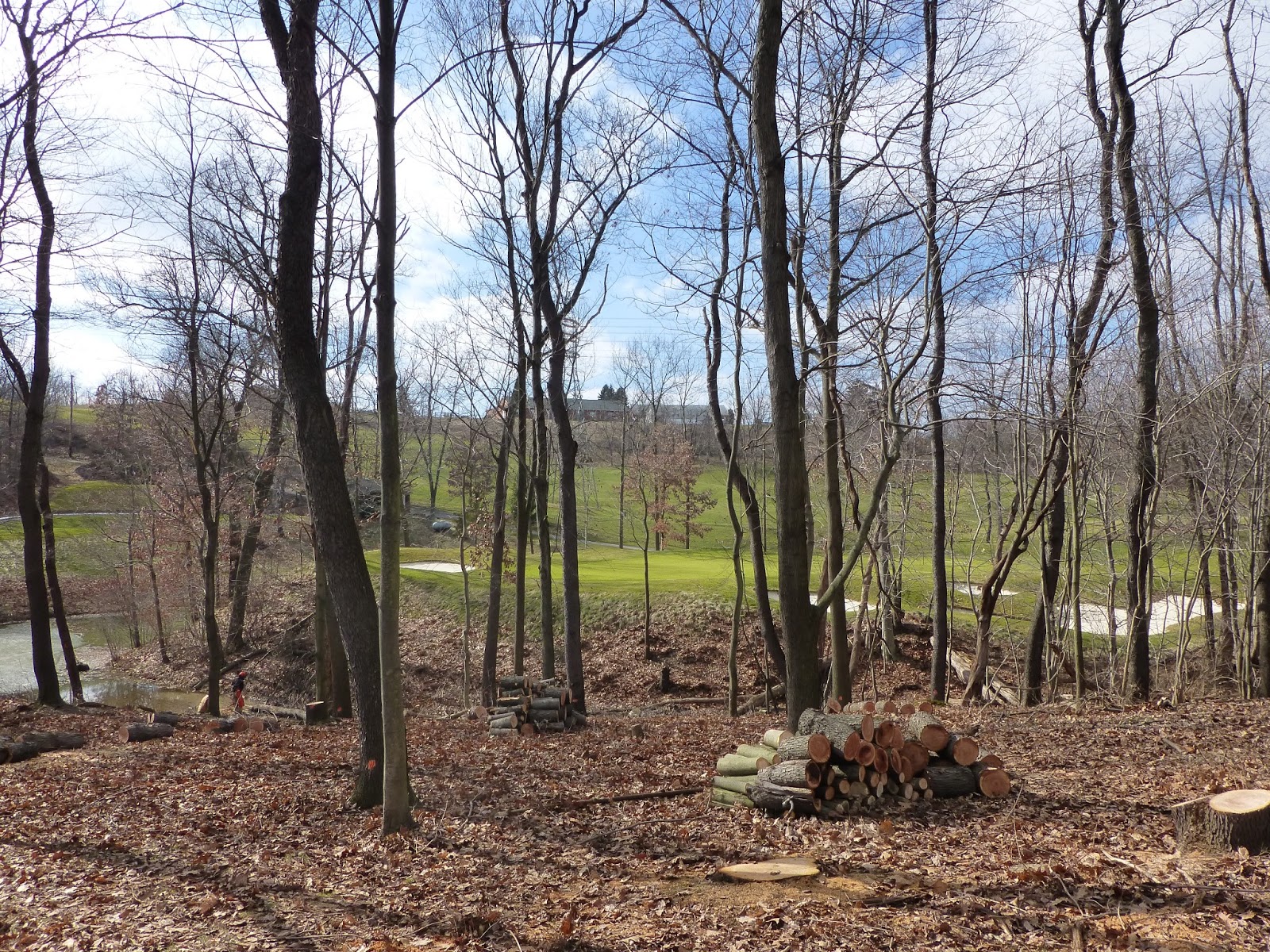 |
| Creating more light and airflow left of 9 green |
 |
| Cutting up trees in ravine at 9 green |
 |
| 4 green - before |
 |
| 4 green - after. Trees removed back right of green |
 |
| 17 tee - before |
 |
| 17 tee - after |
 |
| 8 green. Cutting up dead Ash tree |
 |
| 14 green. Removing dead Ash trees and exposing original rock wall |
Subscribe to:
Posts (Atom)